Persuasive Ad Techniques: Ad Copy That Converts
When it comes to paid advertising, your budget doesn’t buy results — your ad copy does. There are persuasive ad techniques that will help convert visitors into buyers.
You can target the right audience, choose the perfect platform, and even bid smartly… but if your words don’t persuade people to click and convert, it’s money down the drain. We will show you proven persuasive ad techniques that help you write high-converting copy across platforms like Google Ads, Facebook, Instagram, and beyond.
Whether you’re a small business owner running local PPC campaigns or a digital marketer scaling nationwide offers, these tips will help you make every word — and every dollar — count.
And if you’re just getting started with digital marketing overall, check out our Ultimate Guide to Digital Marketing in 2025 to get the whole picture.
Why Ad Copy Still Matters in 2025
With AI, automation, and smart bidding doing so much of the heavy lifting, you might think copy is less important. In reality, copy is more critical than ever. It’s your message — the bridge between attention and action.
Think of your ad copy as your first impression. A great one can drive action immediately. A weak one?
- Scroll
- Click away
- Ignore
And since Google Ads in 2025 and social platforms are increasingly competitive, the ability to write clear, compelling, and conversion-focused copy is a major edge.
Part of Persuasive Ad Techniques is Understanding the Psychology Behind the Click
Persuasive copywriting taps into your audience’s wants, not just what you’re selling.
Ask yourself:
- What problem are they trying to solve?
- What fear, frustration, or desire can you address?
- What emotional triggers do your buyers respond to?
Use this understanding to shape your message. This is the heart of persuasive ad techniques — moving from product features to customer benefits.
As Forbes explains, the art of persuasion in advertising is “about influencing behavior through a mix of emotion, logic, and trust.” That balance should guide every ad you write.
Example:
Instead of: “We install solar panels.”
Try: “Cut your energy bill in half — go solar in just one day.”
Persuasive Ad Techniques: Focus on One Big Promise
Every ad should make one clear promise. Too many messages confuse people, and confused people don’t convert.
Pick the most compelling benefit or offer, and build your copy around it.
Try framing your promise with:
- “Get X without Y” → “Get flawless carpets without harsh chemicals.”
- “X in Y time” → “New roof installed in just 2 days — guaranteed.”
- “Struggle-free” → “Marketing that works, even if you hate social media.”
The more specific, the more believable. This simple trick can instantly boost your CTR (click-through rate).
Use Emotion-Driven Language
People may research with logic, but they buy with emotion.
Use words that spark:
- Excitement: exclusive, proven, limited-time
- Relief: stress-free, no obligation, hassle-free
- Urgency: now, today only, don’t miss out
- Security: guaranteed, trusted, backed by 100+ reviews
As we explain in Retargeting 101, it’s all about building emotional momentum, and copy is your tool.
Keep It Simple. Say It Fast.
You have a fraction of a second to grab attention, especially on social media or mobile.
Make your copy:
- Easy to scan
- Written at a 6th–8th grade reading level
- Short, punchy sentences
- Bullet points or emojis when appropriate
Example:
Bad:
“Our team of certified roofing professionals specializes in providing comprehensive assessments and roof repair solutions customized to your needs.”
Better:
“Leaky roof? We’ll fix it fast. Free inspection today.”
Persuasive Ad Techniques Include a Strong CTA (Call to Action)
Don’t assume people know what to do next — tell them.
Every ad needs a clear call to action that creates urgency and removes friction.
Good CTA examples:
- Schedule your free estimate today
- Claim your discount before midnight
- Book your spot now — space is limited
- Get a free quote in 30 seconds
Avoid weak CTAs like “Learn More” or “Click Here” — unless you pair them with a stronger benefit.
If you’re using Facebook and Instagram Ads, your CTA should also match the button type available on the platform.
Match the Message to the Landing Page
One of the most common conversion killers? A disconnect between the ad and the landing page.
If your ad promises “20% off,” your landing page should lead with that same offer. If your ad says “free consultation,” the landing page shouldn’t ask them to book a demo or pay for anything.
This is called message match, and it’s key for both conversions and ad quality scores.
Tip: Save this idea. We’ll expand on it in an upcoming post on Landing Pages That Convert: How to Maximize ROI from Paid Ads.
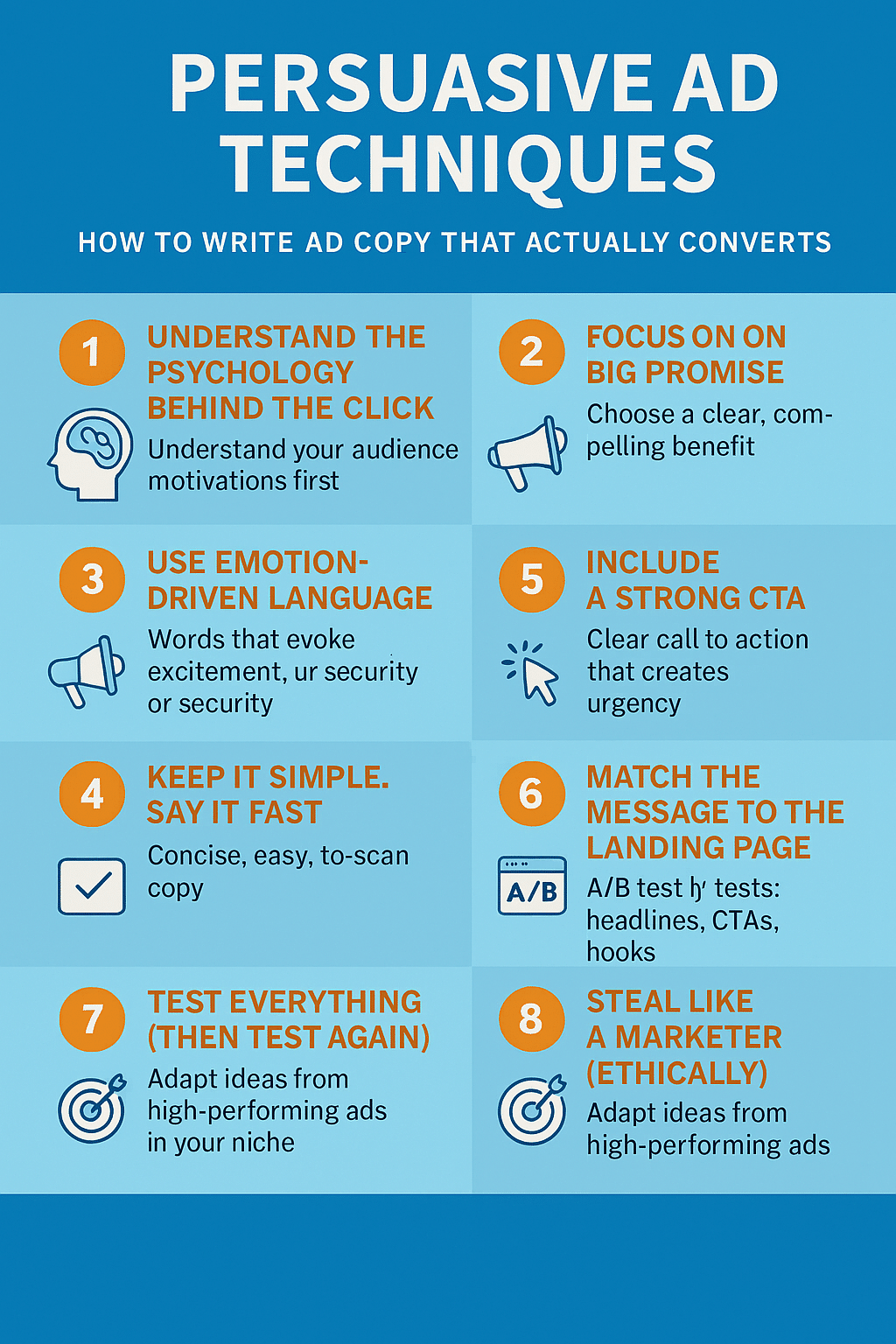
Test Everything (Then Test Again)
Even the best copywriters don’t hit it perfectly the first time. A/B testing is your best friend.
Test things like:
- Headlines
- CTAs
- Length of copy
- Tone (casual vs. professional)
- Emotional vs. logical hooks
Use tools like Google Ads Experiments, Meta’s A/B test tool, or even heatmaps to track engagement. The insights often surprise you.
Want more testing ideas? Bookmark our upcoming post on Maximizing ROAS with Smart Bidding Strategies, which includes advanced testing strategies.
Steal Like a Marketer (Ethically)
Look at what top-performing ads in your niche are doing — then adapt them.
Places to find inspiration:
- Facebook Ad Library
- Google’s Ad Transparency Center
- Competitor newsletters or landing pages
- Ubersuggest’s “Top Pages” under a domain search
Look for patterns, not just phrases. Are they using testimonials? Story-based ads? Humor? Scarcity? Then experiment with your own spin.
The best persuasive ad technique isn’t a fancy formula — it’s knowing what your audience cares about and speaking directly to it.
If you take away one thing from what we have said, let it be this: great ad copy sounds like a conversation, not a pitch.
So the next time you’re writing an ad, think about who you’re helping, what they need, and how to make their life easier — then write like you’re texting a friend.
Need help navigating the world of paid ads? Contact the experts at Webtronix Designs.