Key Points — What You’ll Learn About AI in SEO
- How artificial intelligence is transforming the search landscape and what it means for your visibility.
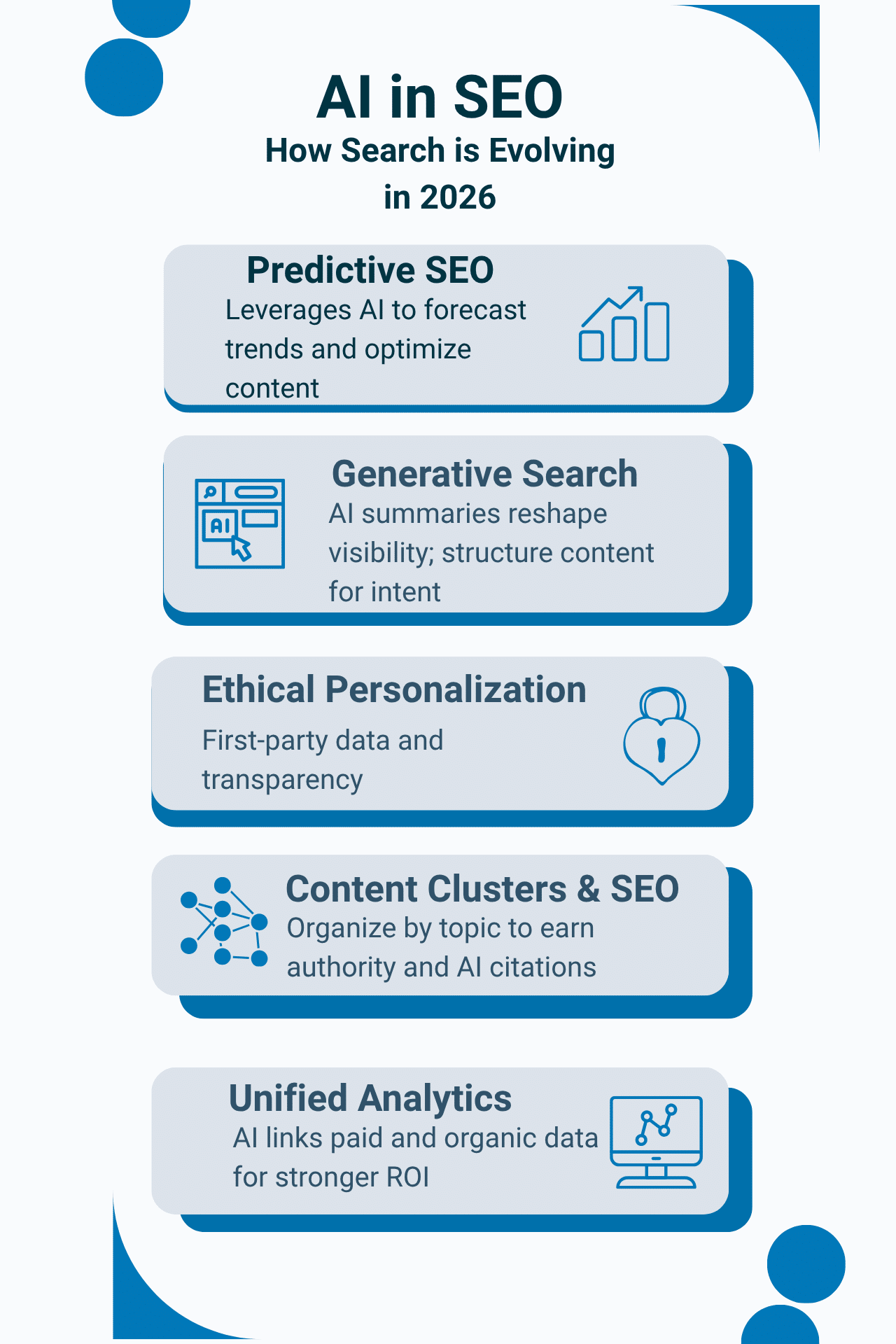
- Why predictive SEO and automation are giving marketers a competitive edge.
- How generative search and AEO (Answer Engine Optimization) are reshaping content strategy.
- Why personalization and data ethics are essential for sustainable success.
- How AI connects paid and organic performance for stronger ROI.
- Which AI SEO tools are leading the industry in 2026 — and how to choose the right ones.
🧠 Why AI in SEO Is Entering Its Smartest Era Yet
Artificial intelligence is fundamentally transforming how search works, and how marketers optimize for it. We’ve moved beyond keywords and backlinks into an era defined by context, intent, and intelligent automation.
At Webtronix Designs, we’ve watched this shift unfold across hundreds of client campaigns. Businesses that thrive in 2026 combine human creativity with AI precision—balancing ethical personalization, first-party data, and integrated analytics.
As Search Engine Journal — Why AI Search Isn’t Overhyped explains, AI isn’t a fad; it’s redefining visibility. Search algorithms now focus on intent, not keyword repetition, rewarding content that satisfies user questions and provides trustworthy, structured answers.
⚙ Predictive SEO and AI in SEO — The Next Leap Forward
Predictive SEO represents one of the biggest advantages AI brings to marketing. By analyzing behavioral patterns, search trends, and competitor performance, predictive tools can forecast what topics will matter months in advance.
According to Forbes — How Predictive Analytics Is Revolutionizing SEO, companies adopting predictive optimization see organic traffic gains between 28% and 42%. This allows teams to anticipate what users will search for, and publish optimized content before demand peaks.
AI platforms like Semrush and Conductor now provide predictive modules that identify emerging queries, automate keyword clustering, and optimize for E-E-A-T signals (Experience, Expertise, Authoritativeness, Trustworthiness). The result: content that ranks faster and stays visible longer.
🌐 Generative Search and AI in SEO Visibility
Generative search engines such as Google AI Overviews, Bing Copilot, and SearchGPT are changing the rules of visibility. Instead of clicking through pages, users often receive AI-generated summaries that cite the most authoritative content directly in the results.
As Search Engine Land — How AI Is Reshaping SEO notes, this is not the death of SEO — it’s evolution. Brands that structure their content clearly, use schema markup, and maintain interconnected content clusters are the ones being cited by AI.
This is why semantic structure and topical depth is important. When your pages interlink logically and answer user intent comprehensively, AI recognizes your site as a trusted authority source.
Explore our post, What Is Digital Marketing and How Does It Work to see how these evolving AI-driven search principles fit into the larger marketing picture.
🔒 Personalization, Privacy, and Trust in AI in SEO
AI-driven personalization delivers unmatched relevance — but it also raises critical questions about data ethics and transparency. Successful brands in 2026 rely on first-party data, obtained through explicit user consent, and communicate how that data shapes personalization.
The balance between helpful and invasive personalization defines brand trust. Regulations like GDPR and CCPA set the baseline, but consumer expectations go further: users want control.
That’s why your marketing email strategy should focus on intent-based segmentation rather than surveillance-driven targeting. Ethical personalization builds long-term loyalty and sustainable SEO value.
📊 How AI in SEO Connects Paid and Organic Performance
For years, paid and organic search operated in silos. Today, AI bridges the gap. Tools like Google’s Performance Max and HubSpot’s AI-powered analytics unify datasets from both channels to find what truly drives ROI.
Integrating your SMART advertising with optimized workflows creates a unified data ecosystem. AI can now detect which content topics improve both paid click-through rates and organic authority — leading to 40–50% better performance across campaigns.
This unified approach turns SEO and advertising into complementary systems rather than competing strategies.
The relationship between AI and visibility now extends beyond organic rankings. Explore how automation and predictive bidding are transforming ad performance in Smart Advertising & Paid Media: Maximizing ROI in 2026.
📚 Content Clusters and AEO — The Future of AI in SEO Authority
Content clusters are no longer optional — they’re the foundation of AI in SEO success. A pillar page surrounded by related subtopics tells AI models that your brand is the definitive authority.
Semrush — AEO vs SEO: Core Differences & How to Win Visibility in Both highlights how AEO rewards structured, intent-based content. Similarly, MarketMuse — What Are Topic Clusters? demonstrates that brands using semantic clusters can increase organic traffic by up to 100%.
To optimize for AEO, audit your content regularly, ensure proper internal linking, and use schema markup to make context and relationships explicit. This is exactly what we integrate into every content Strategy and creation roadmap.
🧩 Top AI SEO Tools to Watch in 2026
The AI SEO ecosystem is expanding quickly. These tools are leading the charge:
- Semrush AI – Predictive keyword forecasting, competitive insights, and automated optimization.
- Surfer AI – Content structure analysis with semantic scoring.
- Ahrefs – Deep backlink intelligence and AI-assisted opportunity mapping.
- HubSpot AI – Connects SEO performance with CRM and email data for unified growth tracking.
- Google Search Console Insights – Real-time feedback for Core Web Vitals and AI visibility signals.
As Conductor — SEO Content Predictions for 2026 emphasizes, future-ready brands are adopting integrated AI workflows to stay ahead of the algorithm curve.
To see how AI is shaping SEO strategies in 2026, visit AI SEO: How AI Is Transforming Search in 2026
🚀 Preparing Your Business for the AI in SEO Era
The transition to AI in SEO presents opportunities, not threats. To stay competitive:
- Build topic-based content ecosystems — structure pages around user intent, not isolated keywords.
- Use AI for analysis, not automation shortcuts — let machine intelligence enhance your strategy, not replace it.
- Embrace ethical personalization — collect consented data and communicate transparency.
- Audit for AEO and Core Web Vitals readiness — speed, structure, and accessibility are crucial.
The Stanford HAI — 2025 AI Index Report confirms that ethical, transparent AI adoption directly correlates with higher long-term brand trust and visibility.
💡 The New SEO Equation — Human Expertise + AI Precision
The winning formula for 2026 is clear: human creativity multiplied by AI precision. Marketers who master this balance will dominate both traditional and generative search.
AI doesn’t replace expertise — it amplifies it. And when paired with clear, authoritative content, it helps brands become go-to resources for both people and machines.
See how AI in SEO fits into a complete omnichannel growth plan, explore our Digital Marketing 2026 post — your roadmap to building smarter, integrated campaigns across every channel.
At Webtronix Designs, we specialize in turning complex AI tools into clear, measurable SEO results. Whether you need a full AI-powered strategy or help integrating predictive and generative tools into your existing campaigns, our team is here to help you dominate search in 2026 and beyond.
Book your 2026 AI-SEO strategy session with Webtronix Designs today — and discover how our data-driven, AI-powered SEO frameworks can future-proof your brand’s visibility.
For a broader look at how AI is changing digital marketing as a whole, check out our main pillar post, Digital Marketing 2026: How AI Is Transforming Search and Strategy.
💬 FAQ
Q: What is AI in SEO and how does it affect ranking?
AI in SEO uses artificial intelligence and predictive analytics to optimize content for context and user intent. Instead of chasing keywords, it builds semantic connections that improve authority and ranking longevity.
Q: How can I optimize for AI-driven search in 2026?
Implement structured data, organize content into topic clusters, collect and use first-party data ethically, and optimize for AEO by answering real user questions clearly.
Q: Which AI tools help most with SEO?
Semrush AI, Surfer AI, Ahrefs, HubSpot AI, and Google Search Console Insights deliver predictive insights, automate optimization, and tie SEO directly to business outcomes.
📘 Additional Resources
- Why AI Search Isn’t Overhyped & What To Focus On Right Now — Search Engine Journal
- How Predictive Analytics Is Revolutionizing SEO — Forbes
- How AI Is Reshaping SEO — Search Engine Land
- AEO vs SEO: Core Differences & How to Win Visibility in Both — Semrush
- SEO Content Predictions for 2026 — Conductor
- What Are Topic Clusters? — MarketMuse
- 2025 AI Index Report — Stanford HAI