


Rankings aren’t the finish line anymore. Being trusted and cited is.
In 2026, the question isn’t just “Where do we rank?” It’s “When someone asks Google AI Mode, ChatGPT, or Perplexity for a recommendation, does our business get named?” AI systems don’t recommend businesses they’re unsure about. They look for a clear, consistent picture of who you are and what you do, and they weigh how people talk about you. That’s why three ideas now sit at the center of trustworthy SEO: entities, entity management, and semantic sentiment. The stakes are real for local businesses. When Sterling Sky’s ranking data compared Google’s new AI-powered local packs with traditional 3-packs, the AI versions surfaced only about 32% as many unique businesses, and 88% of the 322 markets studied showed fewer businesses (Sterling Sky). Fewer slots means the businesses AI trusts most take a bigger share of the visibility. This guide explains how each piece works and, most importantly, how a semantic sentiment scan shows you exactly what to change on your website.
What is entity-based SEO?
An entity is a distinct, identifiable thing: a business, a person, a place, a service, or a concept. Google’s Knowledge Graph and large language models don’t really think in keywords. They think in entities and the relationships between them.
For example, a search engine might understand a business like this: Webtronix Designs → is a → web design agency → located in → Sacramento → offers → local SEO services.
Keyword SEO asks, “Does this page contain the phrase people search for?” Entity-based SEO asks a bigger question: “Does the search engine clearly understand who this business is, what it does, where it operates, and how it relates to other known things? And is it confident enough to recommend it?”
In practice, entity-based SEO comes down to four habits:
- Define your main entity clearly. Use Organization or LocalBusiness schema, the same business name everywhere, a consistent address and phone number, and
sameAslinks to your Google Business Profile, LinkedIn, and other official profiles. - Build one topic per page. Each service page should center on one core entity, such as “technical SEO audit,” and cover the related ideas a customer expects, such as site speed, crawlability, and indexing. That depth is what builds topical authority.
- Connect your pages on purpose. Internal links should tie services to locations, case studies, and the people who do the work.
- Connect people to the brand. Author bios and Person schema for founders and team members show real expertise behind the content, which supports E-E-A-T and AI citations.
What is entity management?
Entity-based SEO happens on your website. Entity management is the ongoing work of keeping your business’s facts consistent and trustworthy everywhere else AI looks.
That includes your Google Business Profile, Yelp and other review sites, industry directories, social profiles, press mentions, chamber of commerce listings, and knowledge bases like Wikidata.
Why it matters: when sources disagree, AI loses confidence. An old address on one directory, a slightly different business name on another, or service descriptions that don’t match your website all send mixed signals. Lower confidence means you’re less likely to be named in an AI answer, even if your website is strong.
Think of entity management as reputation and consistency hygiene for machines. It covers three jobs:
- Audit your citations. Find every listing and fix mismatched names, addresses, phone numbers, hours, and categories.
- Align your descriptions. Describe your services, locations, and specialties the same way across every profile.
- Strengthen your connections. Earn mentions and links from trusted local and industry sources that confirm who you are.
What is semantic sentiment analysis?
Classic sentiment analysis gives you one label: positive, negative, or neutral. It might tell you a page or a batch of reviews is “72% positive.” That’s interesting, but it doesn’t tell you what to fix.
Semantic sentiment analysis goes further. It measures how text feels about specific entities and attributes, in context. Instead of one score, it gives you findings like these:
- People feel positive about your brand but hesitant about pricing.
- Reviews praise your communication but are mixed on turnaround time.
- A service page spends most of its words on the problem in fearful language and barely mentions the resultcustomers get.
- Competitors are strongly associated with “fast” and “affordable,” while your pages never connect your business to those qualities at all.
The shift is from “How do people feel?” to “How do people and our own content describe us, attribute by attribute?” That second question is the one that maps directly to changes you can make.
Why sentiment shapes AI recommendations
When someone asks an AI assistant for “the best web designer in Sacramento” or “an affordable plumber near me,” the AI summarizes what it finds across your Google Business Profile, reviews, website, and mentions around the web. It repeats the dominant framing.
If the associations around your business are lukewarm, or simply missing for the qualities buyers ask about, such as “reliable,” “affordable,” or “fast,” the AI has no reason to put you in the answer. If they’re consistent and positive, you become the safe recommendation.
This is where sentiment connects to trust in 2026:
- Your reviews are training material for the answer. AI tools read review text, not just star ratings. The specific words customers use become the words AI uses to describe you.
- Your website is the evidence. If reviews say “fast turnaround” but your site never mentions timelines, guarantees, or process, the claim has nothing to anchor to.
- Consistency builds confidence. When your site, your profiles, and your reviews tell the same story, AI can describe you with confidence. When they conflict, it hedges or skips you.
- Local visibility is narrowing. With fewer businesses shown in AI-powered local results, the margin between being recommended and being invisible is smaller than ever.
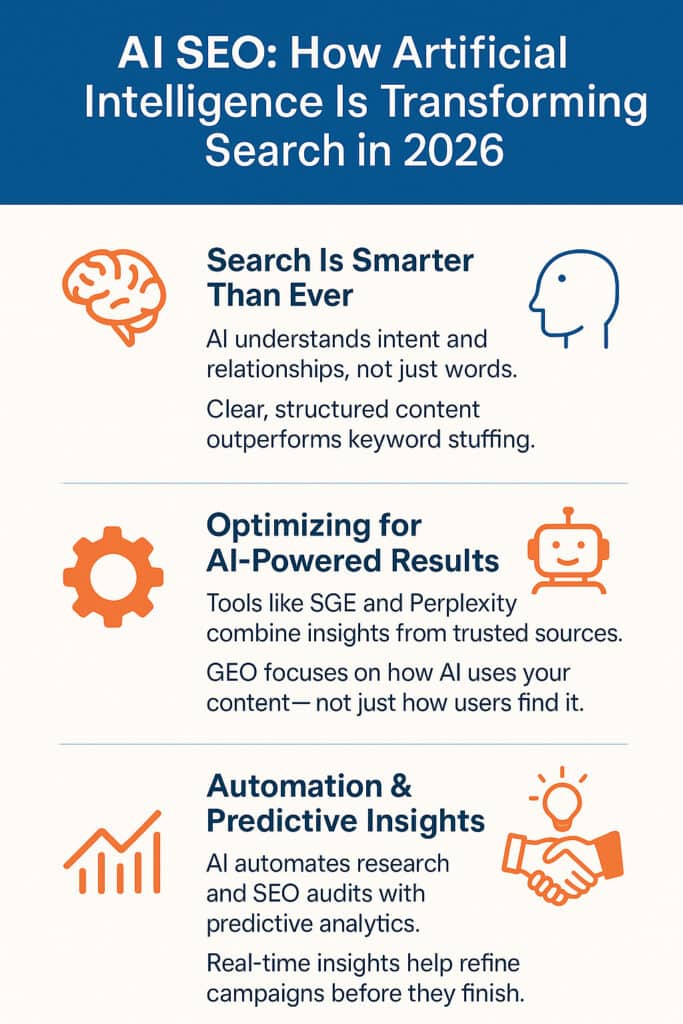
How a semantic sentiment scan tells you what to change
The real value of a scan is that it shows the gap between how you want to be understood and how your content and reviews actually read to a machine. Each finding points to a specific fix.
| What the scan finds | What it means | What to change on your site |
|---|---|---|
| Your main service is rarely named, or named vaguely | Search engines can’t tell what the page is about | Name the service clearly in the H1 and opening paragraph, define it, and add matching schema |
| The page leans heavily on problems, fear, or risk | AI may link your brand to the problem instead of the solution | Rebalance toward outcomes, results, proof, and how you solve it |
| No link to qualities buyers search for | You won’t match “best,” “affordable,” or “fast” type requests | Add real evidence: pricing guidance, timelines, guarantees, and case study results |
| Reviews and website tell different stories | Engines see conflicting signals | Address review themes on-site through FAQs and process pages, and fix the underlying service issue |
| Competitors own positive qualities you don’t | A topical and reputation gap | Build supporting articles, case studies, and FAQs around those qualities |
| Services described differently from page to page | Your entity looks diluted | Standardize how you describe each service, location, and team member |
| Hedging language like “we try to” or “may help” | Reads as weak authority | Rewrite with specific, confident, verifiable claims |
None of these fixes are about stuffing in positive words. They’re about making your strengths explicit, specific, and backed up, so both people and AI can repeat them accurately.
A step-by-step process you can follow
- Define your target entity profile. List the services, locations, people, and qualities you want to be known for, such as “web accessibility,” “Sacramento,” and “fast turnaround.”
- Fix your entity foundation. Clean up your Google Business Profile and citations, and add Organization, LocalBusiness, Service, and Person schema to your site.
- Scan your own content. Run a semantic sentiment scan on your key service, location, and blog pages.
- Scan your reviews and mentions. Include Google, Yelp, and industry review sites, since AI tools read them too.
- Scan your top competitors. See which qualities they own and where your coverage is thin.
- Compare actual against target. Note every missing entity, weak attribute, negative framing, and mismatch between your site and your reviews.
- Rewrite and fill the gaps. Update headings, intros, FAQs, and proof points, and publish supporting content for missing topics.
- Measure in AI answers, not just rankings. Ask ChatGPT, Perplexity, and Google AI Mode the questions your customers ask, track whether you’re named and how you’re described, and re-scan quarterly.
Trust is now something machines measure
SEO trustworthiness used to mean good reviews and solid backlinks. In 2026, it means AI can clearly identify your business, finds the same facts about you everywhere, and sees consistent, specific, positive associations with the qualities your customers care about.
Entity-based SEO makes you understandable. Entity management makes you consistent. Semantic sentiment analysis shows you exactly how you’re being described, and what to change so AI describes you the way you deserve.
Want to know how AI sees your business? Our LocalFind division specializes in AI local SEO, entity optimization, and schema markup for AI citations. Book a strategy call or explore our Local SEO services to get started.
Sources
The State of Local SEO in 2026, Sterling Sky


 What Is Google Guarantee in 2026? Local Services Ads Trust Guide
