Smart Bidding Strategies
Paid advertising is no longer about who spends the most — it’s about who optimizes the smartest. In 2025, the key to profitable ad campaigns lies in your ability to use smart bidding strategies to maximize conversion value.
By combining real-time data, machine learning, and conversion insights, smart bidding removes the guesswork from your bidding process and helps you get more return for every dollar spent. We will show you what smart bidding is, how it works, and how to implement it to improve ROAS while staying aligned with your business goals.
If you’re new to PPC strategy, start with our digital marketing guide for a complete overview of how paid ads fit into your broader online marketing plan.
What Is Smart Bidding (and Why It Works in 2025)
Smart bidding is a subset of automated bidding strategies in platforms like Google Ads and Meta Ads. These strategies use machine learning to optimize your bids in real time — based on user intent, device, location, time of day, and more.
According to Google Ads Help, smart bidding uses auction-time signals to adjust bids for the likelihood of a valuable conversion. That means your campaign doesn’t just aim for more conversions — it aims for the right conversions.
As noted in Search Engine Land, smart bidding delivers better results when your campaigns are structured properly, and your conversion tracking is accurate — both must-haves for maximizing ROI.
How to Set Up Smart Bidding for Maximum Conversion Value
Implementing smart bidding takes more than flipping a switch. You need the right strategy, structure, and signals to make the most of automation.
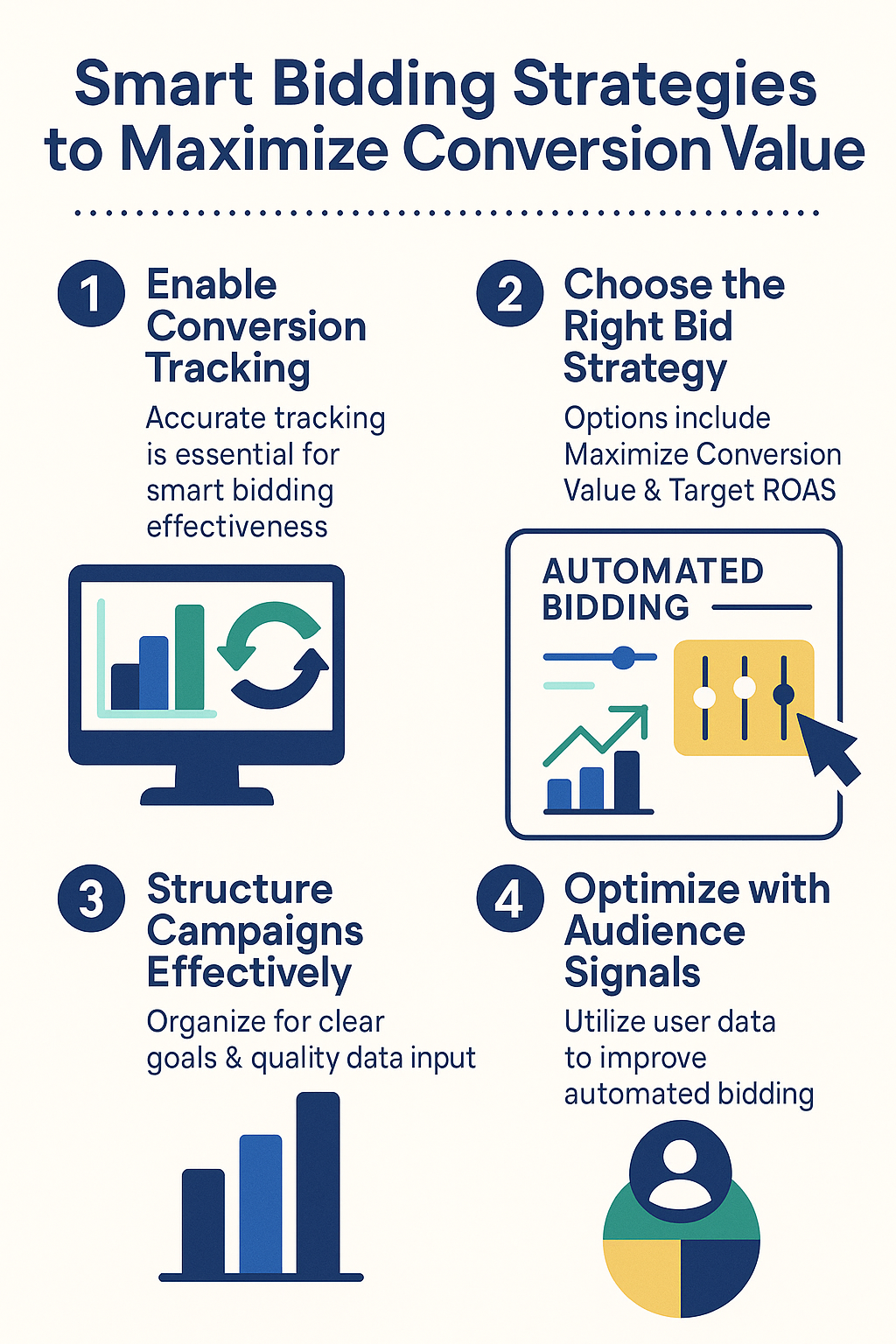
Track Conversions and Assign Value
You can’t maximize conversion value without knowing what a conversion is worth. That’s why accurate conversion tracking is critical.
Start by:
- Setting up Enhanced Conversions (Google) or Conversions API (Meta)
- Assigning dollar values to key actions (purchases, calls, form fills)
- Using value rules to prioritize high-intent users
As highlighted in Semrush’s guide to Google Ads bid strategy, smart bidding requires accurate conversion data to avoid misleading the algorithm.
Choose the Right Smart Bidding Strategy
There are several bidding strategies available in Google Ads:
- Maximize Conversions: Ideal for lead gen with consistent value per lead
- Maximize Conversion Value: Great when conversion values vary (e.g., low-ticket vs. high-ticket purchases)
- Target ROAS (Return on Ad Spend): Bid to achieve a specific return (e.g., 400%)
- Target CPA (Cost per Acquisition): Maintain a predictable cost per lead
Choosing the right strategy depends on your business model. For variable services like roofing or HVAC, Maximize Conversion Value is often the most profitable choice.
Do you need help structuring these campaigns? Our post on Google Ads in 2025 explains how bidding strategies fit into today’s ad platform evolution.
Use Audience Signals and Broad Match Keywords
Feeding the algorithm the right signals speeds up optimization. According to Google Ads Help, combining broad match keywords with smart bidding improves reach and conversion outcomes.
Add layers like:
- Remarketing audiences
- In-market and affinity audiences
- Customer match (email uploads)
- High-converting demographic filters
Broad match keywords give smart bidding the flexibility it needs to identify valuable search intent you might not have predicted manually.
This is clearly demonstrated in Semrush’s keyword match type guide, which explains how match types interact with automated bidding systems.
Allow the Learning Period
Smart bidding needs data to work — and that means giving it time to learn. Don’t panic if performance dips during the first week or two.
According to Google Ads, campaigns typically require 7–14 days or 50 conversions to exit the learning phase. During this time:
- Avoid major budget or bid changes
- Don’t pause or restart campaigns
- Monitor trends, not daily fluctuations
Monitor, Refine, and Iterate
Once you’re out of the learning phase, don’t go on autopilot. Smart bidding needs continuous inputs from you to stay aligned with your goals.
Track:
- ROAS and conversion value/cost
- High-performing keywords and audiences
- Seasonality trends (e.g., HVAC spikes in summer)
- Changes in lead quality
Want to ensure your paid ad spend stays profitable? Our post on tracking ROI from digital marketing campaigns breaks this down further.
As Semrush explains, the best smart bidding strategies are those that you constantly test, adapt, and fine-tune — not set and forget.
Smart bidding is one of the most powerful tools in your paid advertising toolkit — but only if it’s set up with the right structure, data, and strategy.
Combining automation with high-quality inputs like value tracking, audience signals, and thoughtful campaign design, you can confidently maximize conversion value and scale your results across Google Ads and beyond.
Want to apply these same strategies to Meta? Many of these principles also apply to Facebook and Instagram ads, especially with Meta’s own conversion optimization tools.
Visit our e-commerce page to learn more about smart bidding strategies and e-commerce. Check out our home page to learn more about Webtronix Designs Web Agency.
References
- Google Ads Help – About Smart Bidding
- Google Ads Help – Set Up Conversion Tracking for Your Website
- Search Engine Land – Your Guide to Google Ads Smart Bidding
- Facebook Business Help – About Maximizing the Value of Conversions
- Semrush – The Ultimate Guide to Google Ads Bid Strategy